
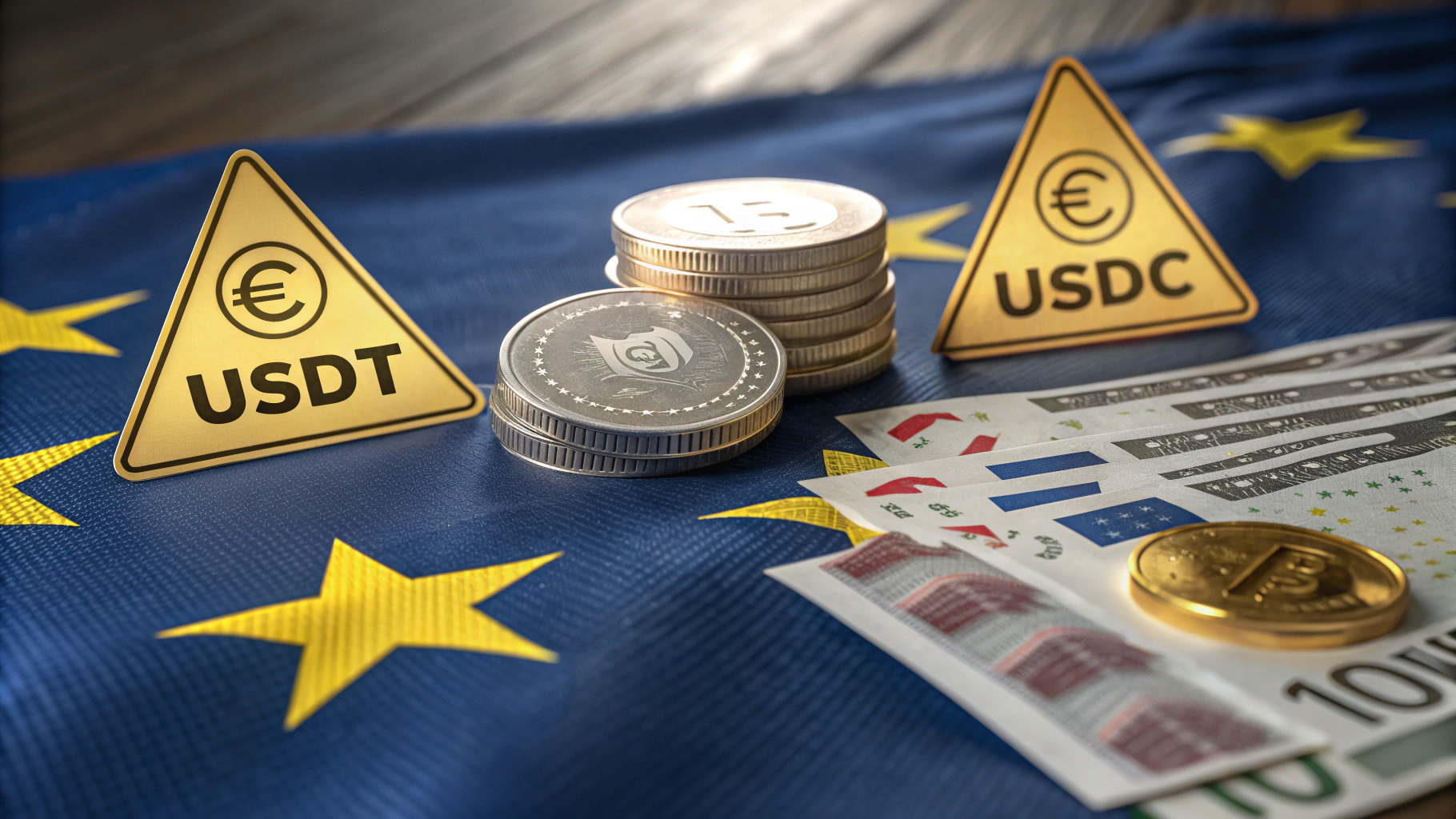
The European cryptocurrency market is facing another important regulatory development after the European Securities and Markets Authority (ESMA) clarified how crypto service providers should handle stablecoins that do not comply with the European Union's Markets in Crypto-Assets Regulation, commonly known as MiCA.
In an opinion published on October 8, 2026, ESMA stated that crypto-asset service providers authorised under MiCA should stop providing services related to non-compliant stablecoins to clients in the European Union. The guidance covers a broad range of activities, including trading, exchanges, transfers, and custody.
The clarification is significant because stablecoins are widely used across the crypto ecosystem for trading, transferring value, and moving between digital assets without relying on traditional bank transfers.
What Is MiCA?
MiCA stands for Markets in Crypto-Assets Regulation. It is the European Union's regulatory framework for crypto-assets and related service providers.
The framework establishes rules for areas such as stablecoin issuance, authorisation, governance, and consumer protection. Its purpose is to create more consistent requirements across EU member states while addressing risks associated with digital assets.
Stablecoins are cryptocurrencies designed to maintain a relatively stable value by referencing another asset, such as the US dollar or the euro. They are commonly used by traders who want to move funds between crypto assets without converting every transaction into traditional currency.
However, not every stablecoin necessarily meets the requirements established by MiCA. Whether a token is compliant depends on its regulatory status and the rules applicable to its issuer and services.
What Did ESMA Clarify?
ESMA's October 8 opinion clarified its supervisory expectations for crypto service providers dealing with stablecoins that do not meet MiCA requirements.
According to the regulator, authorised crypto-asset service providers should cease offering services related to these tokens to EU clients. The guidance covers activities such as:
- Operating cryptocurrency trading platforms.
- Exchanging crypto-assets for other crypto-assets or funds.
- Executing and transmitting trading orders.
- Transferring crypto-assets between accounts or wallets.
- Providing custody and administration services.
- Offering investment advice or portfolio management where applicable.
National regulators are expected to supervise compliance and ensure that platforms implement appropriate technical, contractual, and organisational controls.
For existing holdings that need to be addressed, national authorities should require the necessary remediation as soon as possible and no later than three months after the opinion's publication. Any continued services during this process should be limited to activities needed for an orderly wind-down, such as liquidation, conversion, withdrawal, transfer, or safekeeping.
How Could This Affect Stablecoin Users?
The practical effect will depend on the stablecoin, the platform, and the user's location. Some exchanges may restrict trading pairs, stop accepting deposits, limit purchases, or provide specific arrangements for users who already hold affected assets.
Users should not assume that every stablecoin is being banned across Europe. The guidance concerns stablecoins that do not comply with MiCA, rather than all stablecoins as a category.
Likewise, a change in availability on one exchange does not automatically mean that a token has lost its value or that every wallet has become unusable. Regulatory restrictions on services and the market price of a token are separate issues.
Anyone affected should read their exchange's official announcements, check the relevant deadlines, and confirm which options are available before making a transaction.
What Does This Mean for Crypto Exchanges?
Exchanges serving customers in the European Union may need to review their stablecoin listings, trading pairs, transfer services, custody arrangements, and internal compliance procedures.
Platforms may also need better systems for determining which customers are subject to particular restrictions. Clear communication will be important because users need enough time to understand their options and avoid sending assets to services that no longer support them.
These requirements may increase compliance costs, particularly for businesses that operate across several jurisdictions. At the same time, consistent rules could help legitimate platforms understand their obligations and reduce uncertainty about how stablecoin services should be provided.
Could This Change the Stablecoin Market?
Regulatory requirements can influence which stablecoins exchanges support and which products businesses choose to develop. Tokens that meet the applicable rules may become more attractive to regulated platforms operating in Europe, while non-compliant products may face restrictions on access to EU customers.
This could encourage issuers to strengthen their compliance processes and provide clearer information about their reserves, redemption arrangements, and legal status.
However, the long-term market impact remains uncertain. Trading activity may move between platforms, supported tokens may change, and users may choose different payment or settlement options. The scale of these changes will depend on how the rules are implemented and how companies respond.
What Should Crypto Users Do Now?
Users can take several practical steps to stay informed and reduce the risk of disruption:
- Check official exchange announcements. Look for notices about supported stablecoins, trading restrictions, and withdrawal deadlines.
- Verify the token's regulatory status. Do not rely only on social media posts or claims made by anonymous accounts.
- Review your transaction options. Confirm network support, fees, and destination addresses before moving assets.
- Avoid rushed decisions. Regulatory news can create uncertainty, but acting without checking the facts can lead to avoidable losses.
- Keep records of important transactions. Save confirmations and relevant communications from your service provider.
Users outside the European Union should also remember that these rules do not automatically apply in the same way to every country. Local regulations and the policies of individual exchanges can differ.
The Bigger Picture
ESMA's latest guidance highlights a broader trend in the cryptocurrency industry: regulators are increasingly focused not only on how digital assets are issued, but also on how platforms distribute, exchange, transfer, and safeguard them.
For the market, the challenge will be balancing regulatory compliance with accessibility and innovation. For users, understanding which services and assets are supported in their region is becoming an increasingly important part of managing digital assets responsibly.
The next stage will depend on how national authorities apply the guidance and how exchanges adjust their services. Until then, users should rely on official information rather than assuming that all stablecoins face the same restrictions.
This article is for informational purposes only and does not constitute financial, legal, or investment advice.
Comments 0
Join the conversation
You must be logged in to leave a comment.
Be the first to comment